Understanding Digital Marketing
What is Digital Marketing? Definition
Digital Marketing means using the internet and other digital tools to promote and sell products or services. this can include things Like.
- Showing ads on different – different platforms which is available on internet.
- Posting on social media about our business, brand, works, ( like social media platforms).
- Send personalize email to customer.
- Create helpful or engaging content on website.
The goal is to reach people on online and encourage them to buy or learn more about what are offering.
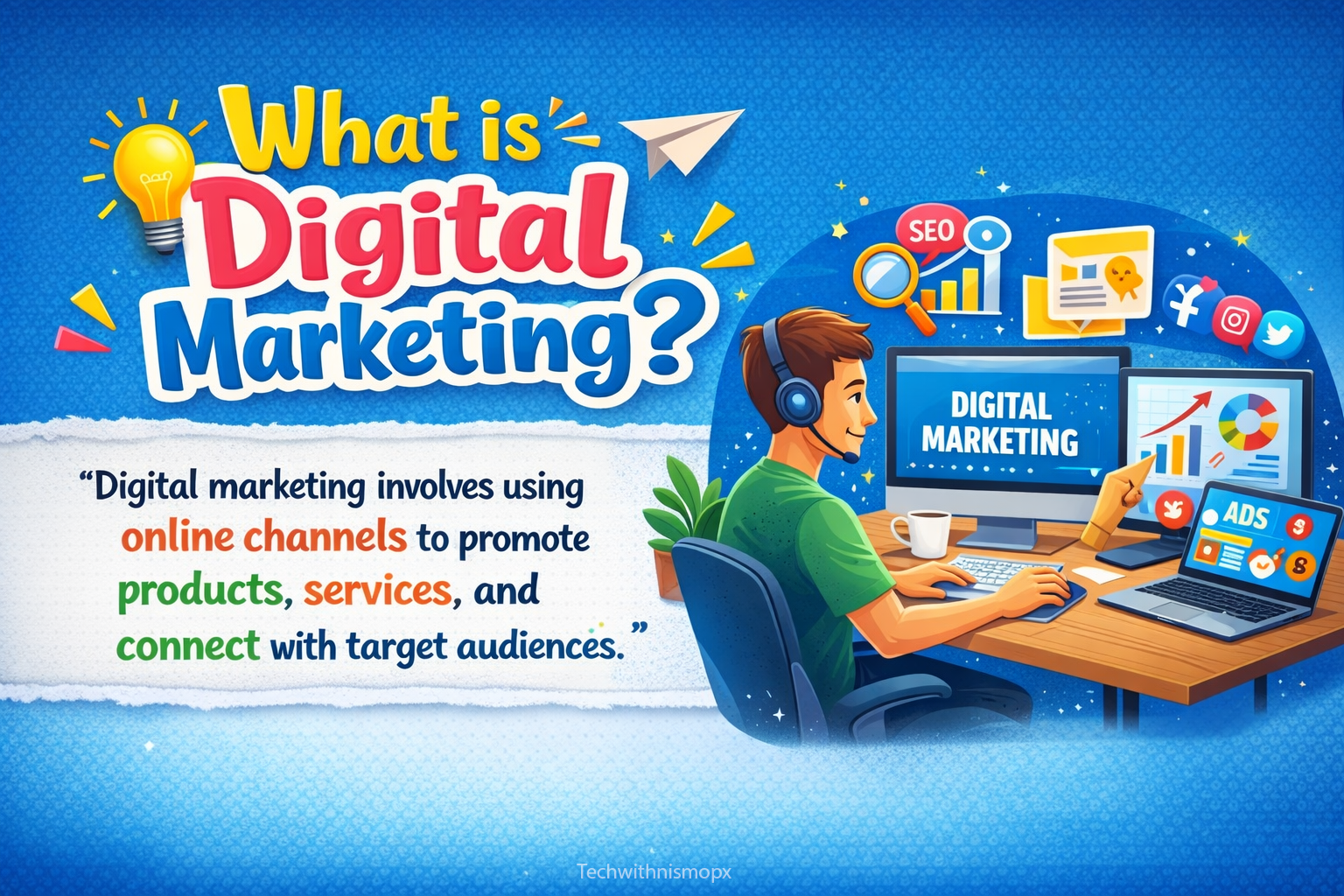
Digital marketing is the process of promoting products, services, or brands through digital platforms such as search engines, websites, social media, email, mobile apps, and online advertising. Unlike traditional marketing, which relies on newspapers, television, radio, and billboards, digital marketing enables businesses to connect with potential customers where they spend most of their time, online.
Today, almost every buying journey begins with an online search. Whether someone wants to purchase a smartphone, compare insurance plans, find a local restaurant, or enroll in an online course, they usually search the internet first. Digital marketing helps businesses appear in front of these potential customers at the right time and with the right message.
One of the biggest advantages of digital marketing is that businesses can measure almost every action. Marketers can track website visitors, ad clicks, conversions, customer behavior, and return on investment (ROI). This data-driven approach allows businesses to improve campaigns continuously instead of relying on assumptions.
Digital marketing is not limited to large corporations. Small businesses, freelancers, startups, educational institutions, healthcare providers, and nonprofit organizations all use digital marketing to build awareness, generate leads, and increase sales. Even individuals use digital marketing to grow personal brands, promote online courses, or become content creators.
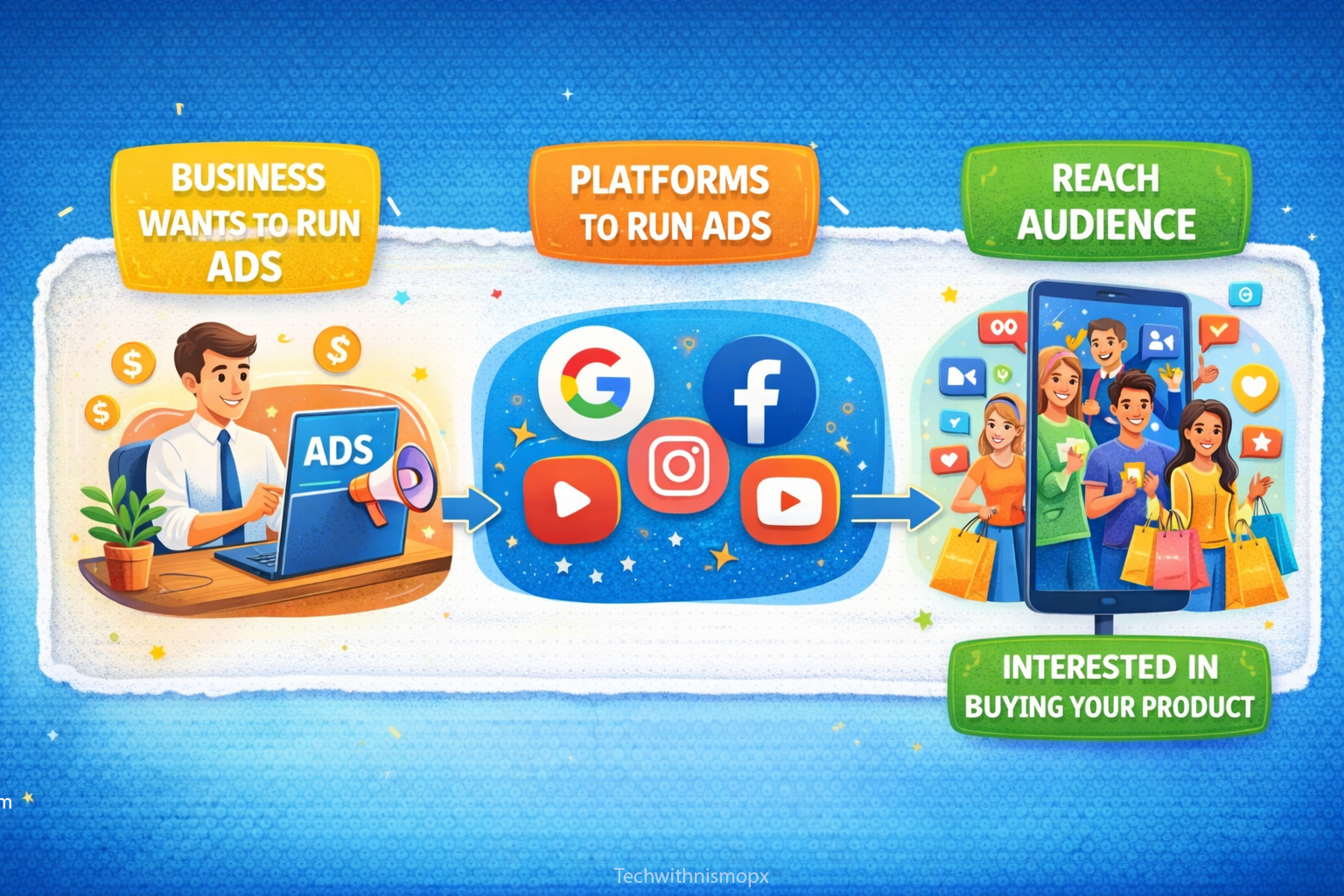
However, successful digital marketing is much more than simply publishing content on online or running advertisements on different platforms. It follows a structured process that helps businesses understand their audience, create valuable content, measure performance, and improve results over time.
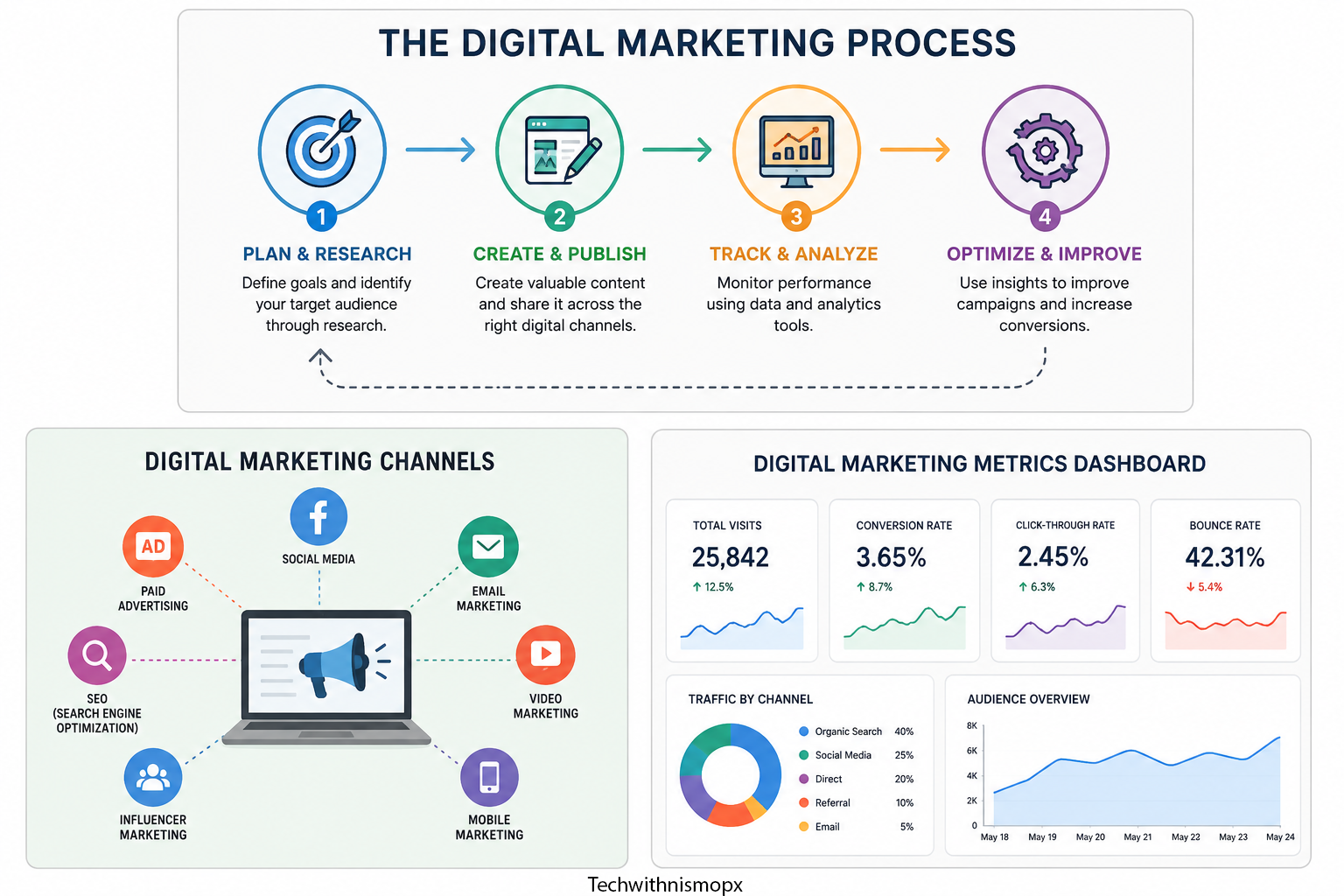
Let’s explore how digital marketing works in four simple stages.
1. Set Goals and Understand Your Target Audience
Every successful digital marketing campaign starts with a clear objective. Businesses first identify what they want to achieve, such as:
- They want to Increasing website visitors?
- Generate qualified leads for there business.
- Want to Boost online sales.
- Improving brand awareness.
- Growing social media engagement.
Once the goals are defined, marketers research their ideal audience. They study customer demographics, interests, online behavior, purchasing habits, challenges, and preferences. Understanding the audience helps businesses create marketing campaigns that deliver the right message to the right people at the right time.
Without proper planning and audience research, even the best marketing campaigns may fail to produce meaningful results.
2. Create Valuable Content and Share It Across Digital Channels
After understanding the audience, the next step is creating content that provides value. Quality content builds trust, answers customer questions, and encourages users to engage with a business.
Digital marketing content may include:
- Informative blog articles.
- Educational videos.
- Social media posts.
- Infographics.
- Email newsletters.
- Product pages.
- Paid advertisements.
Once the content is ready, marketers publish and promote it across multiple online platforms, including search engines, social media networks, email campaigns, and paid advertising channels. Selecting the right platform ensures the content reaches the audience where they spend the most time online.
Consistency in publishing high-quality content plays a major role in long-term digital marketing success.
3. Measure Performance Using Data and Analytics
One of the biggest advantages of digital marketing is the ability to track almost every activity. Businesses can monitor campaign performance using analytics tools that provide valuable insights into user behavior.
Some important performance indicators include:
- Website traffic.
- Click-through rate (CTR).
- Conversion rate.
- Bounce rate.
- User engagement.
- Time spent on pages.
- Lead generation.
- Return on investment (ROI).
These metrics help marketers understand which strategies are producing positive results and which areas require improvement.
Instead of making decisions based on assumptions, businesses rely on real data to optimize their marketing efforts.
4. Improve Campaigns Through Continuous Optimization
Digital marketing is not a one-time activity. It is an ongoing process that requires regular analysis and improvements.
After reviewing campaign data, marketers make adjustments to improve performance. These improvements may include:
- Updating website content.
- Improving landing pages.
- Refining audience targeting.
- Testing different headlines or images.
- Optimizing advertisements.
- Enhancing email campaigns.
- Improving website speed and user experience.
This process, often known as Conversion Rate Optimization (CRO), helps businesses generate better results while making more efficient use of their marketing budget.
Small improvements made consistently can significantly increase traffic, leads, and sales over time.
Understanding the Mechanics of Digital Marketing
Digital marketing has transformed the way businesses promote their products and services in today’s connected world. Instead of relying solely on traditional advertising methods, companies now use a combination of online strategies to reach potential customers, build lasting relationships, and increase sales.
At its core, marketing is about understanding customer needs and delivering the right message at the right time. To accomplish this, businesses use a variety of promotional techniques, including advertising, branding, content creation, email campaigns, social media marketing, and search engine optimization. These activities may be handled by an in-house marketing team or outsourced to a professional digital marketing agency with specialized expertise.
The Shift from Traditional Marketing to Digital Marketing
Before the internet became an essential part of everyday life, businesses mainly relied on newspapers, magazines, television, radio, and outdoor advertising to promote their products and services. While these traditional marketing channels are still valuable in certain industries, digital platforms have created new opportunities to reach larger audiences more efficiently and at a lower cost.
The growth of the internet has significantly changed consumer behavior. Today, people search for information online, compare products, read customer reviews, and interact with brands before making purchasing decisions. As a result, businesses have adapted their marketing strategies to focus on digital channels that offer better audience targeting, measurable performance, and stronger customer engagement.
How Digital Marketing Has Evolved
Digital marketing has continued to evolve alongside advances in technology. In its early years, email marketing became one of the most effective ways for businesses to communicate directly with customers by sending newsletters, promotional offers, and personalized messages.
As search engines became more sophisticated, businesses began optimizing their websites with relevant keywords, high-quality content, and improved website structures to increase their visibility in search engine results. This practice, known as Search Engine Optimization (SEO), remains one of the most effective long-term strategies for attracting organic website traffic.
The emergence of social media platforms further transformed digital marketing. Businesses gained the ability to interact with customers in real time, build online communities, and deliver highly targeted advertisements based on user interests, demographics, and online behavior.
Today, platforms such as Facebook, Instagram, LinkedIn, YouTube, TikTok, and Pinterest enable businesses to connect with specific audiences through engaging and personalized content, making digital marketing more effective than ever before.
The Impact of Mobile Devices on Digital Marketing
The widespread adoption of smartphones has accelerated the growth of digital marketing even further. Consumers now browse websites, watch videos, compare products, read reviews, and complete purchases directly from their mobile devices.
Because mobile devices have become an essential part of daily life, businesses now prioritize mobile-friendly websites, responsive web design, mobile advertising, and app-based marketing strategies. Providing a seamless mobile experience not only improves customer satisfaction but also contributes to better search engine rankings and higher conversion rates.
Why did Understanding Digital Marketing Matters
Digital marketing has become an essential part of modern business success. It allows companies to reach the right audience, monitor campaign performance, optimize marketing strategies, and build long-term relationships with customers.
Whether you are a small business owner, entrepreneur, freelancer, or marketing professional, understanding the mechanics of digital marketing can help you make informed decisions and achieve sustainable business growth.
As technology continues to evolve and consumer behavior changes, businesses that stay informed about the latest digital marketing trends and best practices will be better equipped to remain competitive and succeed in the ever-changing digital marketplace.
Full History of Digital Marketing (Origin, Evolution, Timeline)
Digital marketing has come a long way since the early days of the internet. What started as simple online advertisements has transformed into a powerful industry driven by artificial intelligence, data analytics, and personalized customer experiences. Today, businesses of all sizes rely on digital marketing to connect with their audience, build brand awareness, and increase sales.
Understanding the history of digital marketing helps us appreciate how technology has changed the way businesses communicate with customers and why digital marketing continues to evolve every year.
The Early Internet Era (1990s)
The foundation of digital marketing was established during the 1990s when the internet became available to the general public. As more people gained access to the World Wide Web, businesses recognized the opportunity to create an online presence.
During this period, companies primarily built websites to share information about their products and services. These websites were usually simple, containing basic text, images, and contact details.
Marketing strategies in the 1990s focused mainly on banner advertisements and email marketing. Banner ads were displayed on websites to attract visitors, while email campaigns became one of the first digital methods businesses used to communicate directly with customers.
Although online marketing was still in its early stages, businesses quickly realized that the internet offered opportunities that traditional advertising could not.
The Search Engine Revolution (2000s)
As the internet expanded, finding information became more challenging. Search engines such as Google changed the way people searched for products, services, and information online.
Businesses soon understood that simply having a website was no longer enough. They needed their websites to appear at the top of search engine results to attract visitors.
This gave rise to Search Engine Optimization (SEO), a strategy focused on improving website visibility through quality content, technical optimization, and relevant keywords.
At the same time, Pay-Per-Click (PPC) advertising became increasingly popular. Businesses could display advertisements on search engines and pay only when users clicked on their ads. This made online advertising more measurable and cost-effective compared to many traditional marketing methods.
The 2000s marked the beginning of data-driven marketing, where businesses started tracking website traffic, visitor behavior, and advertising performance.
The Social Media Era (2010s)
The 2010s brought one of the biggest transformations in digital marketing with the rapid growth of social media platforms.
Networks like Facebook, Instagram, LinkedIn, YouTube, Pinterest, and X (formerly Twitter) gave businesses new ways to interact with customers beyond traditional advertising.
Instead of simply promoting products, brands began building communities, creating engaging content, and encouraging conversations with their audience. Businesses used videos, images, live streams, stories, and influencer collaborations to strengthen customer relationships.
Social media also introduced highly targeted advertising. Businesses could reach specific audiences based on age, location, interests, online behavior, and many other factors. This level of targeting significantly improved advertising effectiveness while reducing unnecessary marketing costs.
During this decade, content marketing also became a major strategy. Companies invested in blogs, educational articles, videos, podcasts, and infographics to provide value and build trust with their audience.
The AI and Automation Era (2020s and Beyond)
Today, digital marketing is entering a new era powered by artificial intelligence, automation, and advanced data analysis.
Modern marketing tools can automate repetitive tasks such as email campaigns, social media scheduling, customer segmentation, and lead nurturing. This allows marketers to spend more time focusing on strategy and creativity.
Artificial intelligence is helping businesses better understand customer behavior by analyzing large amounts of data. AI-powered tools can predict buying patterns, recommend products, generate marketing content, and personalize customer experiences in real time.
Chatbots now provide instant customer support around the clock, while predictive analytics helps businesses make smarter marketing decisions based on customer trends.
Voice search, visual search, automation platforms, and AI assistants are also changing how consumers discover products and interact with brands online.
As technology continues to evolve, digital marketing will become even more personalized, efficient, and customer-focused.
The Future of Digital Marketing
The future of digital marketing will be shaped by continuous innovation. Businesses will increasingly rely on artificial intelligence, machine learning, automation, and first-party customer data to create better marketing experiences.
Consumers now expect personalized recommendations, faster customer service, and content that matches their interests. Companies that embrace new technologies while maintaining transparency and customer trust will have a competitive advantage.
However, despite technological advancements, one principle remains unchanged: successful digital marketing is built on understanding customer needs and providing genuine value.
in short digital marketing has evolved from simple websites and banner advertisements into an advanced ecosystem powered by artificial intelligence and data-driven strategies. Each stage of its development has introduced new opportunities for businesses to reach customers more effectively.
Whether through search engines, social media, content marketing, or AI-powered automation, digital marketing continues to transform how businesses grow in the digital world. As technology advances, marketers who continuously learn and adapt will be best positioned for long-term success.
For Example
Imagine you own a bakery and want to grow your business over time.
In the 1990s, you create a simple website with your bakery’s name, photos of cakes, and your phone number so people can find you online. You also send promotional emails to customers about fresh products and special offers.
In the 2000s, you want more people to discover your bakery through search engines. So, you optimize your website with keywords like “birthday cakes near me” and “best bakery in town.” You also run Google ads so that people searching for cakes can find your business quickly.
In the 2010s, you start using social media platforms like Facebook and Instagram. You post pictures of your cakes, share behind-the-scenes baking videos, and ask happy customers to tag your bakery in their posts. You also run social media ads to reach more local customers and build a loyal online community.
In the 2020s and beyond, you use artificial intelligence and automation to make marketing smarter. Your website recommends cakes based on what customers have viewed before, an AI chatbot answers questions instantly, and automated emails send personalized discounts to people who have not placed an order yet.
This one bakery example shows how digital marketing has changed from a basic website and email promotions to search engine marketing, social media engagement, and AI-powered personalization.
Two type of Marketing Traditional Marketing and Digital Marketing
Traditional Marketing:- Traditional marketing is a way of promoting products or services through offline advertising channels. It includes methods like newspapers, television, radio, magazines, brochures, flyers, posters, and billboards. Businesses have used these marketing techniques for many years to reach a wide audience and build brand awareness.
Although digital marketing is growing rapidly, traditional marketing is still effective for reaching local customers and people who spend more time with print or broadcast media. Many businesses continue to use traditional marketing alongside digital marketing to increase their visibility and attract more customers.
SEO Keywords Included: Traditional marketing, offline marketing, traditional advertising, brand awareness, newspapers, television advertising, radio advertising, billboards, marketing methods.
Digital Marketing:-Digital marketing is the process of promoting products or services using online channels and digital technologies. Businesses use websites, search engines, social media platforms, email, mobile apps, and online advertisements to connect with their target audience.
Unlike traditional marketing, digital marketing allows businesses to reach the right people based on their interests, location, and online behavior. It also provides real-time data, making it easy to measure campaign performance, improve results, and achieve a better return on investment (ROI).
Today, digital marketing is one of the most effective ways for businesses of all sizes to increase brand awareness, generate leads, drive website traffic, and grow sales.
SEO Keywords Included: Digital marketing, online marketing, internet marketing, digital advertising, social media marketing, search engine optimization (SEO), online advertising, business growth.
One of the biggest advantages of digital marketing is the ability to measure results. Businesses can track website visitors, advertisement clicks, conversions, customer behavior, and return on investment using analytics tools. This helps marketers understand what is working and improve their campaigns for better performance.
Another important difference is audience targeting. Traditional marketing often displays advertisements to everyone, regardless of whether they are interested in the product. Digital marketing allows businesses to show advertisements only to people who match specific criteria such as age, location, interests, shopping habits, or online behavior. This targeted approach helps reduce wasted advertising spend and increases the chances of generating sales.
Example
Imagine a local gym wants to promote its new fitness membership.
Using traditional marketing, the gym places an advertisement in a local newspaper. Thousands of people may see the advertisement, but many readers might not be interested in joining a gym. As a result, the business spends money reaching people who are unlikely to become customers.
Using digital marketing, the same gym runs a social media advertising campaign. The advertisement is shown only to people between the ages of 25 and 40 who live within 10 kilometers of the gym and have shown an interest in fitness, weight loss, or healthy living. Because the advertisement reaches a highly relevant audience, the gym is more likely to receive membership inquiries and registrations while spending its budget more efficiently.
This example demonstrates why many businesses today prefer digital marketing. It provides better targeting, measurable results, and greater flexibility, allowing companies to make informed decisions and maximize their marketing investment.
| Traditional Marketing | Digital Marketing |
|---|
| Uses television, newspapers, radio, magazines, flyers, and billboards to promote products or services to a wide audience through offline channels. | Uses websites, search engines, social media platforms, email campaigns, online advertisements, and mobile apps to reach customers through digital channels. |
| It is often difficult to measure the exact results of a campaign because businesses cannot always track how many people saw the advertisement or took action after viewing it. | It is easy to monitor campaign performance using analytics tools, reports, and tracking systems that show clicks, impressions, conversions, and customer behavior. |
| It usually targets a broad audience, which means the same message is shown to many different people whether they are interested in the product or not. | It allows businesses to target specific audiences based on interests, age, gender, location, online activity, and purchasing behavior, making the message more relevant. |
| It generally requires a larger advertising budget because printing, broadcasting, and placing ads in traditional media can be expensive. | It is suitable for businesses of all sizes because digital campaigns can be started with small budgets and scaled according to performance and goals. |
| Customer interaction is limited because people usually only see the advertisement without being able to respond immediately or engage with the brand. | It enables two-way communication through comments, messages, reviews, likes, shares, and direct responses, helping businesses build stronger relationships with customers. |
| Changes to a campaign can be slow and costly because printed materials or broadcast schedules cannot be updated instantly once they are released. | Campaigns can be updated, paused, improved, or optimized instantly based on real-time performance data and customer response. |
| It often reaches people in a specific local area or within the coverage of a newspaper, radio station, or television channel. | It can reach local, national, or global audiences depending on the campaign settings, making it much more flexible and scalable. |
Digital marketing is more than posting on social media or running online advertisements. It is a structured process that helps businesses attract the right audience, build trust, generate leads, and convert those leads into loyal customers. Each step plays an important role, and skipping one can reduce the effectiveness of the entire marketing strategy.
Whether you run a small local business or a large online store, understanding how digital marketing works can help you create campaigns that deliver measurable results.
Step 1: Understand Your Target Audience
Every successful marketing campaign starts with knowing who your customers are. Instead of trying to reach everyone, businesses focus on the people who are most likely to buy their products or services.
This involves researching customer demographics, interests, online behavior, problems, goals, and purchasing habits. Creating customer personas helps businesses understand what their audience needs and how they search for solutions online.
Why This Step Matters
If you don’t understand your audience, even the best advertisement may fail because it reaches the wrong people. Marketing becomes much more effective when your message speaks directly to the customer’s needs.
Best Practice
Before launching any campaign, answer these questions:
- Who is my ideal customer?
Your ideal customer is the person most likely to need your product or service, benefit from it, and be willing to pay for it. This includes people who match your target age, location, interests, income level, profession, or specific problem you solve. - What problem am I solving?
You are solving the main challenge, need, or pain point that your customer faces. A strong business does not just sell a product—it provides a solution that saves time, reduces effort, improves results, or makes life easier for the customer. - Where does my audience spend time online?
Your audience spends time on the platforms they use most often, such as Google, YouTube, Facebook, Instagram, LinkedIn, TikTok, forums, blogs, or email. The right platform depends on your audience’s age, interests, and online habits. - What motivates them to make a purchase?
Customers are usually motivated by trust, value, convenience, price, quality, reviews, urgency, and how well the product solves their problem. They are more likely to buy when they feel confident that your offer is useful, reliable, and worth the money.
Step 2: Build a Strong Online Presence
After identifying the target audience, businesses create a professional online presence. This usually starts with a fast, mobile-friendly website because it acts as the company’s digital storefront.
A complete online presence may also include:
A business website, a regularly updated blog, social media profiles, business listings, customer review platforms, and email subscription forms all work together to create a strong online presence and help customers find, trust, and connect with the business more easily.
Customers often research a business before making a purchase. A professional online presence builds credibility and increases trust.
Example
If someone searches for a local bakery and finds an attractive website with product photos, customer reviews, pricing, and contact information, they are much more likely to place an order than if they find no online presence at all.
Step 3: Create Valuable Content
Content is one of the most important parts of digital marketing because it helps educate, inform, and build relationships with potential customers.
Instead of constantly trying to sell products, businesses should create content that answers common questions and solves real problems.
Examples include:
- Educational blog articles.
- Step-by-step tutorials.
- Videos.
- Infographics.
- Podcasts.
- Case studies.
- Product comparison guides.
- Frequently asked questions.
High-quality content not only attracts visitors but also improves search engine rankings and establishes the business as a trusted source of information.
Common Mistake
Many businesses only publish promotional content. Readers are more likely to engage with useful, informative content that genuinely helps them make better decisions.
Step 4: Drive Qualified Traffic
Creating a website is only the beginning. The next step is bringing the right visitors to that website.
Businesses use several digital marketing channels to increase traffic:
Search Engine Optimization (SEO)
SEO improves website visibility in search engines by creating helpful content, optimizing website structure, improving page speed, and targeting relevant search terms.
Paid Advertising
Platforms like Google Ads and social media advertising allow businesses to reach potential customers immediately through targeted campaigns.
Social Media Marketing
Regularly sharing useful content on social media helps increase brand awareness, engage audiences, and drive visitors to the website.
Email Marketing
Email campaigns help businesses stay connected with subscribers by sharing useful information, promotions, and product updates.
Referral Marketing
Visitors may also arrive from partner websites, guest articles, online communities, or recommendations from satisfied customers.
Influencer Marketing
Collaborating with trusted creators allows businesses to introduce their products to highly engaged audiences who already trust the influencer’s recommendations.
Step 5: Convert Visitors into Customers
Getting traffic is important, but traffic alone does not generate revenue. Businesses must encourage visitors to take meaningful actions.
Common conversion goals include:
- Purchasing a product.
- Requesting a quotation.
- Booking a consultation.
- Filling out a contact form.
- Downloading a free guide.
- Joining an email newsletter.
Businesses improve conversion rates by using clear calls to action, simple navigation, fast-loading pages, secure checkout processes, and persuasive product descriptions.
Example
Instead of ending an article with “Thank you for reading,” a business could offer a free downloadable marketing checklist in exchange for the visitor’s email address. This creates an opportunity for future communication and lead nurturing.
Step 6: Measure, Analyze, and Improve
One of the greatest advantages of digital marketing is that almost every activity can be measured.
Businesses should regularly check a few important numbers to understand how well their marketing is working. These metrics show whether people are visiting the website, staying interested, and taking the next step.
- Website traffic: the number of people visiting your website.
- Bounce rate: the percentage of visitors who leave after viewing only one page.
- Average session duration: how long visitors stay on your site.
- Click-through rate (CTR): how many people click on your ad or link after seeing it.
- Conversion rate: the percentage of visitors who complete a desired action, such as making a purchase or filling out a form.
- Cost per acquisition (CPA): how much money you spend to get one customer or lead.
- Return on investment (ROI): how much profit you earn compared to what you spent on marketing.
- Customer lifetime value (CLV): the total amount of money a customer is likely to spend with your business over time.
These insights help marketers understand which strategies are performing well and where improvements are needed.
Successful digital marketing is an ongoing process of testing, learning, and optimizing—not a one-time activity.
Real-Life Example
Imagine you have launched an online digital marketing course.
You begin by researching your audience and discover that many beginners want to learn digital marketing without paying high tuition fees.
To help them, you publish detailed blog articles explaining SEO, social media marketing, Google Ads, email marketing, and content marketing in simple language. You also create free YouTube tutorials and share practical tips on LinkedIn and Instagram.
To attract more visitors, you optimize your articles for search engines and run Google Ads targeting people searching for phrases like “best digital marketing course for beginners” and “learn digital marketing online.”
On your website, you offer a free beginner’s guide in exchange for an email address. New subscribers receive weekly newsletters containing useful tips, industry updates, and real-world case studies. Over time, these educational emails build trust, and many subscribers decide to enroll in your paid course.
By regularly monitoring website traffic, conversion rates, and student feedback, you improve your content and marketing campaigns. This continuous improvement helps your business attract more qualified leads, increase enrollments, and build a loyal community of learners.
Types of Digital Marketing
Digital marketing is not a single marketing technique. It is a collection of strategies that help businesses attract potential customers, build trust, generate qualified leads, and increase sales. Each strategy has a different purpose. Some methods help people discover your business, while others focus on building long-term relationships or encouraging customers to make a purchase.
The most successful businesses do not rely on just one marketing channel. Instead, they combine several digital marketing methods based on their goals, target audience, industry, and budget. For example, an online clothing store may use SEO to attract visitors from search engines, social media to engage customers, email marketing to promote new collections, and paid advertising to generate immediate sales.
Understanding how each type of digital marketing works allows you to choose the right strategy instead of spending time and money on techniques that may not suit your business.
1. Search Engine Optimization (SEO)
What Is SEO?
Search Engine Optimization (SEO) is the process of improving a website so that it appears higher in search engine results when people search for information, products, or services related to your business.
For example, imagine someone types “best digital marketing course in India” into Google. Hundreds of websites may provide an answer, but most users only click one of the first few results. SEO helps improve your chances of appearing in those top positions without paying for every visitor.
Unlike paid advertisements, SEO focuses on earning organic traffic. Once your pages rank well, they can continue attracting visitors for months or even years with regular updates and maintenance.
Why Is SEO Important?
Many people think SEO is only about ranking higher on Google, but its real purpose is to connect users with the most helpful and relevant information.
A well-optimized website can:
- Increase organic website traffic without paying for every click.
- Build trust because users often view high-ranking websites as more reliable.
- Generate leads and sales from people already searching for your products or services.
- Improve the overall user experience with faster loading pages and better navigation.
- Deliver long-term results that continue even after you stop spending on advertising.
For many businesses, SEO becomes one of the most cost-effective digital marketing strategies because a single high-quality article can attract visitors for years.
How Search Engines Decide Which Website to Rank
Search engines aim to provide the most useful answer to every search query. To do this, they evaluate many signals before deciding which pages should appear higher in the results. The goal is not just to find pages with keywords, but to find pages that are genuinely helpful, trustworthy, and easy to use.
Some of the most important ranking factors include:
High-Quality Content
Your content should fully answer the reader’s question in a clear and useful way. It should be original, accurate, well-organized, and updated when needed. Search engines and users both prefer content that adds real value instead of repeating information that already exists on many other websites.
For AdSense approval, this is especially important. Thin, copied, or overly generic content can make a website look low value. A strong article should explain the topic in detail, include examples, and help the reader solve a problem or learn something new.
Search Intent
Understanding why someone is searching is just as important as using the right keywords. For example, a person searching for “how to improve website speed” wants practical steps, not a sales pitch. If your content matches the user’s intent, it becomes more useful and more likely to perform well.
To improve this, think about what the reader wants at each stage. Are they looking for information, a comparison, a solution, or a product? When your content matches that need, it creates a better experience and builds trust.
Relevant Keywords
Keywords help search engines understand what your page is about. However, good SEO is not about repeating the same phrase again and again. Instead, use natural language, related terms, and questions that people commonly ask.
A well-written article should sound human and easy to read. If the content feels forced or stuffed with keywords, it can reduce quality and make the page less useful for visitors.
Website Speed
Slow websites can frustrate visitors and cause them to leave before the page loads. A fast website improves the reading experience and helps users move through your content more easily.
To improve speed, compress images, avoid unnecessary scripts, and choose reliable hosting. A faster website not only helps users but also shows that your site is well maintained, which is important for both search visibility and AdSense review.
Mobile-Friendly Design
Most people browse on smartphones, so your website should work well on smaller screens. Text should be easy to read, buttons should be easy to tap, and the layout should adjust properly to different devices.
If a visitor has to zoom in, scroll sideways, or struggle to find information, the experience becomes poor. A mobile-friendly design makes your site more professional and more likely to keep visitors engaged.
Secure Website
Using HTTPS protects the connection between your website and your visitors. It helps keep data secure and gives users more confidence when they browse your site.
A secure website is now considered a basic requirement for a trustworthy online presence. It also shows that you care about user safety, which is important when building a site that may be reviewed for AdSense approval.
User Experience
Search engines prefer websites that are easy to navigate and pleasant to use. Clear menus, readable formatting, descriptive headings, and logical page structure help visitors find what they need quickly.
Good user experience also means avoiding clutter. Pages should not feel overloaded with pop-ups, distracting ads, or confusing layouts. A clean and organized website makes it easier for readers to stay longer and explore more pages.
Quality Backlinks
When respected websites link to your content, search engines often treat those links as a sign that your page is useful and trustworthy. However, not all backlinks are equal. A few links from relevant, high-quality websites are usually more valuable than many links from weak or unrelated sites.
The best way to earn backlinks is by publishing content that people actually want to reference. Helpful guides, original insights, useful tools, and well-researched articles are more likely to attract natural links over time.
For AdSense approval, backlinks are not the main requirement, but they can help show that your website has value and is part of a real online presence.
Example: How SEO Helps a Small Business
Imagine you own a bakery in Ahmedabad that specializes in custom birthday cakes.
Instead of relying only on social media, you publish a detailed guide titled “How to Choose the Perfect Birthday Cake for Every Age Group.” The article includes tips, serving size recommendations, design ideas, pricing guidance, and photos of your work.
You also optimize the page with relevant keywords, improve your website speed, add descriptive headings, and ensure the site works well on mobile devices.
A few months later, people searching for terms such as “birthday cake ideas,” “custom birthday cakes,” or “bakery near me” begin finding your article through search engines. Some readers simply use your advice, while others decide to contact your bakery and place an order.
This example shows that SEO is not just about getting more traffic. It is about attracting visitors who are already interested in what you offer, making them more likely to become customers.
Types of SEO
Search Engine Optimization is not a single activity. It is made up of several specialized areas that work together to improve a website’s visibility in search engines. Think of SEO like building a house. Strong content, a solid technical foundation, and a good reputation all work together to create a successful website.
Many beginners believe that adding keywords is enough to rank on Google. In reality, search engines evaluate content quality, website performance, authority, user experience, and many other factors before deciding where a page should appear.
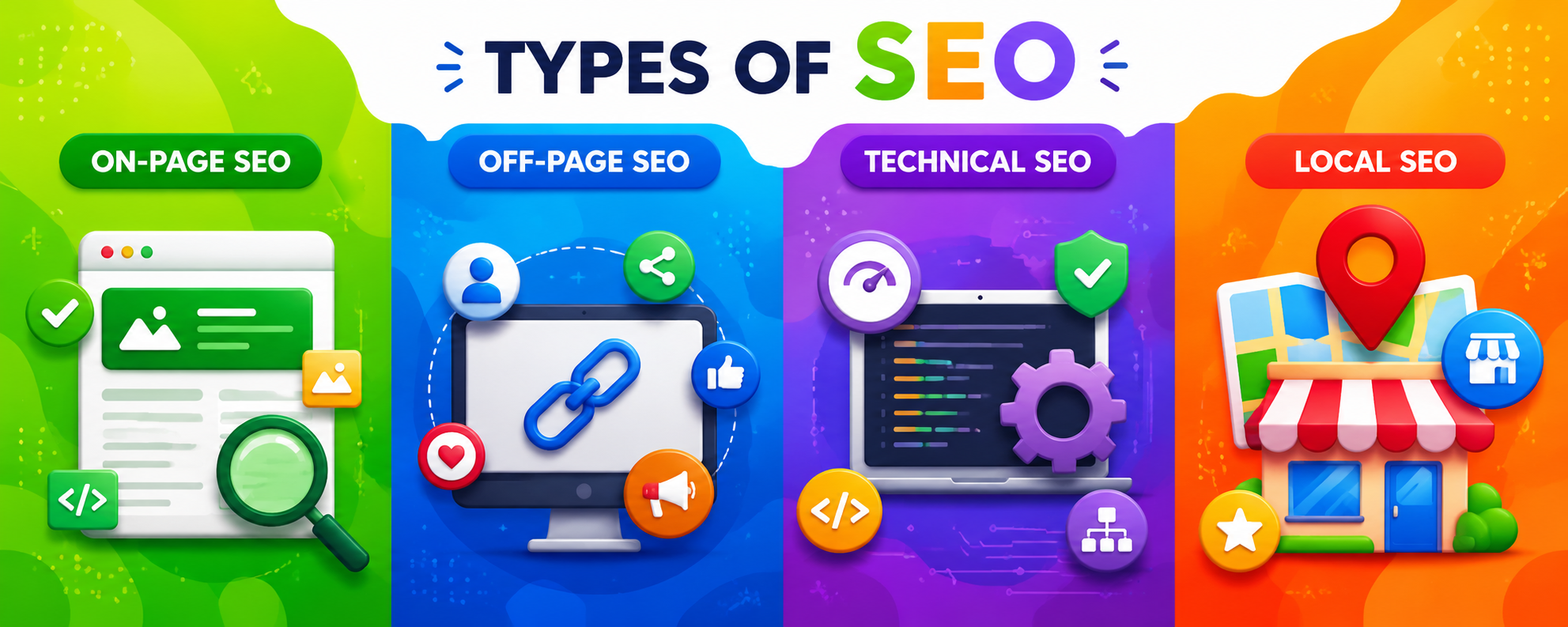
The four main types of SEO are On-Page SEO, Off-Page SEO, Technical SEO, and Local SEO. Each one has a different purpose, but they all contribute to better search visibility.
1. On-Page SEO
What Is On-Page SEO?
On-Page SEO refers to everything you optimize directly on your website. Its goal is to help both visitors and search engines understand what each page is about.
A well-optimized page answers the user’s question clearly, loads quickly, uses descriptive headings, and provides a positive reading experience.
Important Elements of On-Page SEO
- Write content that is genuinely useful, easy to understand, and answers the reader’s real questions.
- Give every page a clear title and a simple meta description so both people and search engines know what the page is about.
- Use headings to break the content into small, readable sections that guide the reader step by step.
- Include important keywords naturally, the way a real person would use them in conversation, not by forcing them into every sentence.
- Optimize images with descriptive file names and alt text so they support the content and remain accessible to everyone.
- Add internal links to related articles so readers can explore more helpful information without getting lost.
- Keep the writing easy to read by using short paragraphs, simple language, and bullet points where they make the message clearer.
Real-Life Example
Suppose you publish an article titled “How to Learn Digital Marketing from Scratch.”
Instead of writing a short 500-word article, you create a complete beginner’s guide that includes learning steps, free resources, examples, frequently asked questions, and practical tips.
You also optimize the title, headings, images, and internal links to related articles. This makes your page more useful for readers and easier for search engines to understand.
Common Mistakes
Many beginners:
- Stuffing keywords into every paragraph makes the content sound unnatural and difficult to read, which can frustrate visitors and reduce trust in your website.
- Publishing very short articles often fails to answer the reader’s full question, so the page may feel incomplete and less useful.
- Ignoring internal linking can make it harder for readers to discover related content and for search engines to understand how your pages connect.
- Copying content from other websites adds no original value and can damage your credibility because readers usually want fresh, trustworthy information.
- Using misleading titles may attract clicks at first, but it disappoints readers when the content does not match their expectations, which can increase bounce rates and hurt long-term trust.
2. Off-Page SEO
What Is Off-Page SEO?
Off-Page SEO refers to everything you do outside your own website to improve how search engines and users view your site. It is about building trust, credibility, and authority. If on-page SEO helps search engines understand your content, off-page SEO helps them understand whether other people trust your content.
This type of SEO matters because search engines do not only look at what you say about yourself. They also look at what others say about you. When trusted websites mention your content, link to your pages, or recommend your business, it sends a strong signal that your website offers something useful. In simple words, good off-page SEO helps your website earn respect on the internet.
The stronger your reputation becomes across the web, the more likely your pages are to rank well. This is why off-page SEO is not just about links. It is about building a positive online presence that shows your website is helpful, reliable, and worth visiting.
Off-Page SEO Activities
- Earning backlinks from trusted websites. This tells search engines that other websites value your content and consider it worth recommending.
- Writing guest articles on relevant websites. This helps you reach new readers while also building authority in your field.
- Getting mentioned in industry blogs, news sites, or online communities. These mentions increase visibility and help people discover your brand.
- Sharing content on social media. While social shares may not directly control rankings, they help more people see your content and can lead to natural traffic and links.
- Encouraging satisfied customers to leave reviews. Positive reviews build trust, especially for local businesses and service providers.
- Building relationships with other websites in your industry. Strong relationships often lead to natural mentions, collaborations, and long-term growth.
Each of these activities sends a message. Backlinks say your content is useful. Reviews say your business is trustworthy. Social sharing says people find your content worth discussing. Guest posting says you have knowledge worth sharing. Together, these signals help search engines and readers see your website as more credible.
Real-Life Example
Imagine you publish a detailed guide explaining Google Ads for beginners. The article is clear, practical, and written in a way that helps new learners understand the basics without confusion.
Later, a well-known marketing blog reads your guide and links to it in one of their articles because they believe their readers will benefit from it. That backlink acts like a vote of confidence. It tells search engines that your content is valuable enough for another trusted website to recommend.
Over time, this kind of recognition can improve your rankings, bring more visitors to your site, and increase your chances of earning leads or customers. The message here is simple: when other people trust your content, search engines are more likely to trust it too.
Mistakes that can be avoid
Avoid:
- Buying backlinks. Paid links often come from low-quality sources and can harm your website instead of helping it.
- Joining spam link exchanges. These may create artificial signals that search engines can detect and ignore.
- Posting links in unrelated forums or comment sections. Random link placement usually adds no real value and can make your site look untrustworthy.
- Creating thousands of low-quality backlinks. A large number of weak links is not as useful as a few strong, relevant ones.
- Focusing only on links and ignoring reputation. Off-page SEO works best when people genuinely find your content helpful.
The main lesson is that off-page SEO should be built on trust, not shortcuts. A few trustworthy backlinks from relevant websites are far more valuable than hundreds of poor-quality links. When your website earns real recommendations from real sources, it sends a powerful message: your content deserves attention because it helps people.
3. Technical SEO
What Is Technical SEO?
Technical SEO is the process of improving the behind-the-scenes parts of your website so search engines can crawl, understand, and index your pages properly. It is not only about search engines, though. It is also about creating a smooth experience for real people who visit your site.
If your website has technical problems, even excellent content may not perform well. A slow, confusing, or broken website can frustrate visitors and make search engines less confident about your pages. Technical SEO helps remove those barriers so your content has a fair chance to succeed.
Technical SEO Includes
- Improving page speed. A fast website keeps visitors engaged and reduces the chance that they leave before reading your content. The message here is simple: people value speed, and search engines do too.
- Making the website mobile-friendly. Most users browse on phones, so your website should look good and work properly on smaller screens. If a page is difficult to use on mobile, many visitors will leave quickly.
- Using HTTPS security. A secure website protects user data and builds trust. When visitors see that your site is safe, they are more likely to stay, interact, and return.
- Fixing broken links. Broken links create a poor experience because they lead users to pages that no longer exist. Keeping links updated shows that your website is maintained carefully and respectfully.
- Creating XML sitemaps. A sitemap helps search engines discover your important pages more easily. This is especially useful for larger websites or new websites that need better visibility.
- Improving website structure. A clear structure helps both users and search engines understand how your content is organized. When pages are arranged logically, visitors can find information faster and search engines can crawl your site more efficiently.
- Removing duplicate pages. Duplicate content can confuse search engines and weaken the value of your pages. Keeping each page unique helps your website send a clearer message about what it offers.
- Fixing crawl and indexing issues. If search engines cannot access or index your pages correctly, those pages may never appear in search results. Solving these issues ensures your content has the opportunity to be discovered.
For Example
Suppose your website takes eight seconds to load.
Many visitors will leave before they even read your content because people expect websites to open quickly. A slow site sends the message that the user experience is not a priority.
After compressing images, improving hosting, and removing unnecessary scripts, your loading time drops to two seconds.
Now visitors can access your content faster, stay longer, and browse more pages. Search engines also notice that users are having a better experience, which can support stronger performance over time.
This example shows an important lesson: technical SEO is not just a technical task. It directly affects how people feel when they use your website.
Common Mistakes
- Slow website speed. A slow site can drive visitors away before they see your message. Speed matters because attention is limited.
- Broken pages (404 errors). When users click a link and land on a missing page, it creates frustration and reduces trust. Every broken page is a missed opportunity to help someone.
- Large image files. Heavy images can make pages load slowly, especially on mobile devices. Optimizing images helps your site stay efficient without losing quality.
- Duplicate content. Repeating the same content across multiple pages can confuse search engines and weaken your site’s clarity. Each page should have a clear purpose.
- Missing SSL certificate. Without HTTPS, visitors may feel unsafe sharing information or browsing your site. Security is part of trust.
- Poor mobile experience. If buttons are too small, text is hard to read, or layouts break on phones, users will leave quickly. A mobile-friendly site respects the way people actually browse today.
4. Local SEO
What Is Local SEO?
Local SEO is the process of improving your online presence so that people in your area can find your business when they search for nearby products or services. It helps your business appear in local search results, map listings, and location-based searches at the exact moment people are looking for help.
This type of SEO is especially valuable for businesses that serve customers in a specific city, town, or neighborhood. Restaurants, hospitals, gyms, salons, coaching centers, clinics, repair shops, and local service providers all benefit from local SEO because their customers usually want fast, nearby, and trustworthy options.
Local SEO sends an important message to readers and customers: your business is real, reachable, and ready to serve people in their area. When done well, it builds trust and makes it easier for local customers to choose you over competitors.
Local SEO Includes
- Creating and optimizing a Google Business Profile.
This helps your business appear on Google Maps and in local search results. A complete profile with photos, services, hours, and contact details tells customers that your business is active and reliable. - Using accurate business information.
Your business name, address, and phone number should always be correct. Accurate information helps customers contact you easily and shows search engines that your business details can be trusted. - Collecting customer reviews.
Reviews act as social proof. When people see positive feedback from real customers, they feel more confident about choosing your business. Reviews also show that your business has served others successfully. - Adding location-based keywords.
Including city names, area names, and service locations helps search engines understand where your business operates. This makes it easier for nearby customers to discover your website. - Creating pages for specific service areas.
If you serve more than one location, separate pages for each area can help you reach more local customers. These pages should explain what you offer in that location and why people there should choose you. - Maintaining consistent business details across directories.
Your information should match on your website, Google Business Profile, social media pages, and business directories. Consistency builds trust and reduces confusion for both users and search engines.
Real-Life Example
Imagine someone searches for “digital marketing institute in Jamnagar.”
If your business profile is complete, your website clearly mentions Jamnagar, your contact details are correct, and your students have left genuine reviews, your business has a much better chance of appearing in local search results.
This example shows an important message: local SEO is not only about ranking higher. It is about helping the right people find the right business at the right time. When your information is clear and trustworthy, customers are more likely to contact you, visit your location, or enroll in your service.
Common Mistakes
- Incorrect phone numbers.
If customers cannot reach you, they may quickly move to another business. Wrong contact details create frustration and reduce trust. - Outdated business hours.
People often search for local businesses when they need immediate help. If your hours are wrong, customers may arrive when you are closed and lose confidence in your business. - Few customer reviews.
A business with no reviews may seem inactive or untested. Reviews help new customers feel safe and informed before making a decision. - Missing address details.
If your location is unclear, both search engines and customers may struggle to understand where you operate. A complete address makes your business easier to find. - Inconsistent business information across websites.
When your name, address, or phone number changes from one platform to another, it creates confusion. Consistency helps search engines trust your business and helps customers contact you without problems.
Local SEO is more than a marketing technique. It is a way of showing nearby customers that your business is genuine, helpful, and easy to reach. When your local presence is accurate, visible, and trustworthy, you increase your chances of attracting people who are ready to buy, visit, or contact you.
2. Pay-Per-Click (PPC) Advertising
What Is Pay-Per-Click (PPC) Advertising?
Pay-Per-Click (PPC) advertising is a digital marketing model in which advertisers pay only when someone clicks on their advertisement. Instead of waiting for organic rankings to improve over time, PPC allows a business to appear in front of potential customers almost immediately.
You can think of PPC as a paid shortcut to visibility. When your campaign is active, your ad can appear on search engines or social media platforms for people who are already looking for products, services, or information related to your business.
For example, if someone searches for “best digital marketing course online,” Google may show sponsored ads above the organic results. If the user clicks your ad, you pay for that click only. You do not pay for impressions alone.
This makes PPC one of the fastest ways to attract targeted visitors, generate leads, and increase sales.
Why Businesses Use PPC Advertising
Businesses use PPC because it can produce results much faster than organic marketing methods such as SEO. While SEO often takes months of consistent effort before rankings improve, PPC campaigns can begin generating traffic within hours of launch.
PPC is especially useful when a business wants to:
- Launch a new website or product.
- Promote a limited-time offer or seasonal sale.
- Generate leads quickly.
- Increase online sales.
- Test demand for a new service.
- Reach a highly specific audience.
Another major advantage of PPC is measurability. Every campaign can be tracked. You can see how many people viewed the ad, clicked it, visited the landing page, submitted a form, or made a purchase. This makes it easier to understand whether your budget is being used effectively.
How Pay-Per-Click Advertising Works
Although PPC may seem technical at first, the process is straightforward when broken into clear steps.
Step 1: Define Your Goal
Before creating ads, decide what you want the campaign to achieve.
Your goal may be to:
- Increase website traffic.
- Generate leads.
- Sell products.
- Receive phone calls.
- Promote a course.
- Collect registrations.
A clear goal helps you build a campaign that focuses on results instead of just clicks.
Step 2: Research Keywords
Keywords are the words or phrases people type into search engines.
For example, if you run a digital marketing institute, people may search for:
- Digital Marketing Course.
- Learn SEO Online.
- Google Ads Training.
- Best Digital Marketing Institute.
- Online Marketing Certification.
Choosing keywords that match user intent helps your ads appear at the right time.
Step 3: Create Compelling Advertisements
A good PPC ad should answer one question:
Why should someone click this ad instead of another one?
A strong ad usually includes:
- A clear headline.
- A short description.
- A benefit for the user.
- A strong call to action.
For example, instead of writing:
Best Course Available
You could write:
Learn Digital Marketing with Live Projects – Enroll Today
Specific and benefit-focused ads usually perform better than vague promotional messages.
Step 4: Set Your Budget
One of the biggest advantages of PPC is budget control.
You can decide:
- Your daily budget.
- Maximum cost per click.
- Total campaign budget.
- Target locations.
- Devices to target.
- Days and times your ads should appear.
This flexibility makes PPC suitable for both small businesses and large companies.
Step 5: Launch and Monitor the Campaign
After launching the campaign, the work is not finished.
Successful advertisers regularly monitor:
- Click-through rate (CTR).
- Cost per click (CPC).
- Conversion rate.
- Cost per conversion.
- Search terms.
- Quality Score.
- Return on ad spend (ROAS).
By reviewing these metrics, you can improve ads, pause poor-performing keywords, increase budgets for successful campaigns, and make better decisions over time.
Step-by-Step Tutorial: Creating a Basic PPC Campaign
This section is especially useful if you want to make your article more original and more helpful for readers. Adding your own screenshots here can improve the quality of the page and make it more trustworthy.
Step 1: Open Your Advertising Account
Create or log in to your Google Ads, Meta Ads, LinkedIn Ads, or other PPC platform account.
Add your original screenshot here:
- Screenshot of the dashboard after login.
- Screenshot of the account overview page.
Step 2: Choose the Campaign Objective
Select the goal that matches your business need, such as leads, sales, website traffic, or brand awareness.
Add your original screenshot here:
- Screenshot of the objective selection screen.
Step 3: Select the Campaign Type
Choose the type of campaign you want to run, such as search ads, display ads, video ads, or social media ads.
Add your original screenshot here:
- Screenshot of campaign type options.
Step 4: Set Location, Language, and Budget
Choose where your ads should appear, which language your audience uses, and how much you want to spend each day.
Add your original screenshot here:
- Screenshot of location targeting.
- Screenshot of daily budget settings.
Step 5: Add Keywords or Audience Targeting
For search campaigns, enter keywords that match user intent. For social campaigns, define your audience by age, interests, behavior, or location.
Add your original screenshot here:
- Screenshot of keyword planner results.
- Screenshot of audience targeting settings.
Step 6: Write the Advertisement
Create a headline, description, and call to action that clearly explain your offer.
Add your original screenshot here:
- Screenshot of ad creation screen.
- Screenshot of ad preview.
Step 7: Send Traffic to a Relevant Landing Page
Do not send users to a generic homepage if you can avoid it. Send them to a page that matches the ad message and helps them take action.
Add your original screenshot here:
- Screenshot of the landing page used in the campaign.
Step 8: Review and Publish
Check spelling, targeting, budget, and tracking before launching the campaign.
Add your original screenshot here:
- Screenshot of the final review page before publishing.
Budget Planning Template for PPC
A simple budget calculator can make your article more useful and original. You can also offer this as a downloadable template for readers.
Basic PPC Budget Formula
- Estimated clicks = Daily budget ÷ Average CPC
- Estimated leads = Estimated clicks × Conversion rate
- Estimated cost per lead = Daily budget ÷ Estimated leads
Example Budget Table
| Daily Budget | Average CPC | Estimated Clicks | Conversion Rate | Estimated Leads |
|---|---|---|---|---|
| ₹500 | ₹25 | 20 | 10% | 2 |
| ₹1,000 | ₹20 | 50 | 8% | 4 |
| ₹2,000 | ₹40 | 50 | 12% | 6 |
Simple Ad Copy Template
You can also include a downloadable ad copy template like this:
- Headline: [Primary keyword + benefit]
- Description: [What you offer + why it matters]
- Call to Action: [Enroll Now / Get Quote / Book a Demo]
- Final URL: [Relevant landing page]
This kind of practical resource adds value and makes the article more useful for readers.
Popular PPC Advertising Platforms
Different platforms help businesses reach different audiences.
Google Search Ads
Google Search Ads display text advertisements when people search for products or services. They are ideal for reaching users with strong buying intent because those users are actively searching for a solution.
Google Display Ads
Display ads appear on websites, blogs, and mobile apps. These image-based ads are useful for brand awareness and remarketing.
YouTube Ads
Video ads appear before, during, or after YouTube videos. Businesses use YouTube to demonstrate products, educate customers, and build brand recognition.
Facebook Ads
Facebook allows businesses to target users based on demographics, interests, behavior, and previous interactions. It is useful for lead generation, e-commerce, and local businesses.
Instagram Ads
Instagram is highly visual, making it ideal for fashion brands, restaurants, travel companies, fitness businesses, beauty products, and online stores.
LinkedIn Ads
LinkedIn is designed for professionals. Companies often use LinkedIn Ads for B2B services, corporate training, software products, and recruitment campaigns.
Pinterest Ads
Pinterest ads work well for businesses that rely on visual inspiration, such as home décor, crafts, weddings, recipes, fashion, and lifestyle products.
Microsoft Ads
Microsoft Advertising reaches users through Bing and partner networks. Competition is often lower than Google, which can reduce advertising costs.
Real Campaign Case Study
Here is a practical example of a 30-day Google Ads campaign for a digital marketing institute. Replace the numbers with your own campaign data and add original screenshots from your account to make the article more authentic.
Business Overview
Business Type: Digital marketing institute
Campaign Goal: Increase admissions
Platform Used: Google Ads
Campaign Duration: 30 days
Total Ad Spend: ₹25,000
Target Keywords:
- Digital Marketing Course.
- SEO Training.
- Google Ads Certification.
- Online Digital Marketing Classes.
Campaign Setup
The campaign was structured as a search-only campaign targeting users actively looking for digital marketing training. The ads were shown in a specific local area to attract students who were more likely to visit the institute or enroll online.
Targeting Details:
- Location: Jamnagar and nearby areas.
- Devices: Mobile and desktop.
- Ad Schedule: 9:00 AM to 9:00 PM.
- Landing Page: Dedicated admission page.
- Match Types: Phrase match and exact match.
Performance Results
- Impressions: 52,480.
- Clicks: 1,684.
- CTR: 3.21%.
- Average CPC: ₹14.82.
- Leads: 214.
- Enrollments: 27.
- Cost per Lead: ₹116.82.
- Cost per Enrollment: ₹925.93.
What the Campaign Showed
The campaign produced useful insights that helped improve performance over time.
- Best-performing keywords:
The keywords Digital Marketing Course and SEO Training brought the highest-quality traffic because they showed strong learning intent. - Best-performing ad copy:
Ads that included phrases like Live Classes, Placement Support, and Industry Certification received the highest CTR. - Best-converting landing page:
A dedicated admission page converted better than the homepage because it focused only on course details, fees, benefits, and the inquiry form. - Best audience segment:
Mobile users generated most of the leads, especially during evening hours when students were more active. - Optimization changes that improved results:
Adding negative keywords such as free, pdf, jobs, and salary reduced irrelevant clicks and improved lead quality.
Screenshots to Include
To make this section stronger and more original, add your own screenshots from the campaign dashboard.
- Original screenshot of the campaign setup.
- Original screenshot of keyword targeting.
- Original screenshot of ad performance.
- Original screenshot of conversions or leads.
Key Takeaways
This campaign showed that PPC works best when the targeting, ad copy, and landing page all match the user’s search intent. Broad traffic alone did not produce the best results. Instead, specific keywords, clear messaging, and a focused admission page generated better leads at a lower cost.
Example of How to Present Your Own Campaign
If you want to write your own case study, explain:
- Which keywords brought the best traffic.
- Which ad copy got the highest CTR.
- Which landing page converted better.
- Which audience segment performed best.
- What changes improved the results.
This type of real-world reporting makes the article much more useful than a basic definition page.
Advantages of PPC Advertising
PPC offers several benefits when campaigns are planned and managed properly.
Instant Visibility
Unlike SEO, which may take months to improve rankings, PPC ads can begin appearing almost immediately after approval.
Highly Targeted Audience
Businesses can target users based on:
- Location.
- Age.
- Language.
- Interests.
- Device.
- Search behavior.
- Previous website visits.
This helps reduce wasted ad spend.
Complete Budget Control
You decide how much to spend each day. Campaigns can be paused, resumed, or adjusted at any time.
Measurable Results
Every click, impression, conversion, and sale can be tracked, making it easier to understand which ads generate the best return on investment.
Fast Lead Generation
PPC helps businesses reach people who are already looking for solutions, making it one of the fastest ways to generate inquiries, appointments, and sales.
Common Mistakes and How to Fix Them
Many businesses waste money on PPC because they launch campaigns without proper planning. Below are some common mistakes and practical ways to fix them.
| Common Mistake | Why It Hurts Performance | How to Fix It |
|---|---|---|
| Choosing keywords that are too broad | Attracts irrelevant clicks | Use specific, intent-based keywords |
| Sending traffic to the homepage | Reduces conversions | Use a landing page that matches the ad |
| Ignoring negative keywords | Wastes budget on unwanted searches | Add negative keywords regularly |
| Writing vague ad copy | Lowers click-through rate | Use clear benefits and a strong CTA |
| Not tracking conversions | Makes it hard to measure success | Set up conversion tracking properly |
| Focusing only on clicks | Clicks do not always mean sales | Track leads, sales, and cost per conversion |
| Not testing different ads | Limits improvement | Run A/B tests on headlines and descriptions |
Frequently Asked Questions from Students
Including FAQs based on real student queries can make your article more helpful and more original.
1. How much budget do I need to start PPC?
You can start with a small budget if you are testing a campaign. The right budget depends on your industry, keyword competition, and campaign goal.
2. Is PPC better than SEO?
PPC is faster, while SEO is more long-term. Many businesses use both together because they serve different purposes.
3. How long does PPC take to show results?
PPC can start generating traffic soon after launch, but strong performance usually improves after testing and optimization.
4. What is a good CTR in PPC?
A good CTR depends on the platform, industry, and keyword type. Search campaigns often perform differently from display or social campaigns.
5. Why do I get clicks but no leads?
This usually happens when the ad message does not match the landing page, the offer is unclear, or the page is not persuasive enough.
6. Can small businesses use PPC?
Yes. PPC can work for small businesses if the budget is managed carefully and the targeting is specific.
Lessons Learned from Actual Campaigns
If you want your article to feel more practical and trustworthy, include lessons learned from real campaign work. These observations make the content more valuable than a simple textbook explanation.
Important Lessons
- A relevant landing page often matters more than a lower CPC.
- Broad keywords can waste budget quickly.
- Negative keywords save money and improve lead quality.
- Ads should match the landing page message.
- Small tests are better than large risky budgets.
- Conversion tracking is more important than click tracking alone.
- Good offers usually outperform clever but unclear ad copy.
- Campaigns improve when they are reviewed regularly, not left unattended.
These lessons are especially useful because they come from real campaign behavior, not just theory.
Final Thoughts
Pay-Per-Click advertising is one of the fastest ways to attract potential customers online. However, success depends on careful planning, relevant keywords, compelling advertisements, strong landing pages, and continuous optimization.
If you want your article to be more useful and more likely to meet AdSense quality expectations, include:
- Original screenshots of campaigns you have run.
- Real case studies with results.
- Budget calculators or downloadable templates.
- Step-by-step tutorials using your own images.
- Frequently asked questions based on real student queries.
- Common mistakes and how to fix them.
- Personal observations or lessons learned from actual campaigns.
These additions make the content more original, practical, and valuable for readers. They also improve the overall user experience, which is important when trying to build a site that is suitable for the Google publisher network.
PPC works best when it is combined with SEO, quality content, and a positive user experience. When all of these elements work together, they can support long-term business growth and stronger marketing results.
Career Opportunities in Digital Marketing
As businesses continue expanding online, demand for digital marketing professionals remains strong.
Popular career paths include:
| Job Role | Primary Responsibility |
|---|---|
| SEO Specialist | Improve website rankings |
| Content Writer | Create articles, guides, and website content |
| Social Media Manager | Manage social platforms and engagement |
| PPC Specialist | Run paid advertising campaigns |
| Email Marketing Specialist | Develop and optimize email campaigns |
| Content Strategist | Plan long-term content initiatives |
| Digital Marketing Executive | Coordinate multiple marketing activities |
| Marketing Analyst | Analyze campaign performance |
| Marketing Automation Specialist | Build automated customer journeys |
| Digital Marketing Manager | Lead strategy and oversee teams |
Professionals often specialize in one area before expanding into broader marketing roles.