What Is PPC? Learn the Basics of Pay-Per-Click Marketing
What Is PPC?
If you have ever searched for a product or service on Google, you have probably noticed that the first few results often include the word “Sponsored.” These sponsored listings are advertisements created using Pay-Per-Click (PPC) advertising.
PPC is one of the fastest ways for businesses to appear in front of potential customers. Unlike Search Engine Optimization (SEO), which may take months to improve search rankings, PPC campaigns can begin driving targeted visitors shortly after they are launched. Businesses pay only when someone clicks on their advertisement, making it easier to measure results and control advertising costs.
However, paying for clicks does not guarantee success. A well-managed PPC campaign requires careful planning, relevant keywords, compelling ad copy, and a landing page that genuinely helps visitors. Without these elements, businesses may spend money without generating meaningful results.
How Does PPC Work?
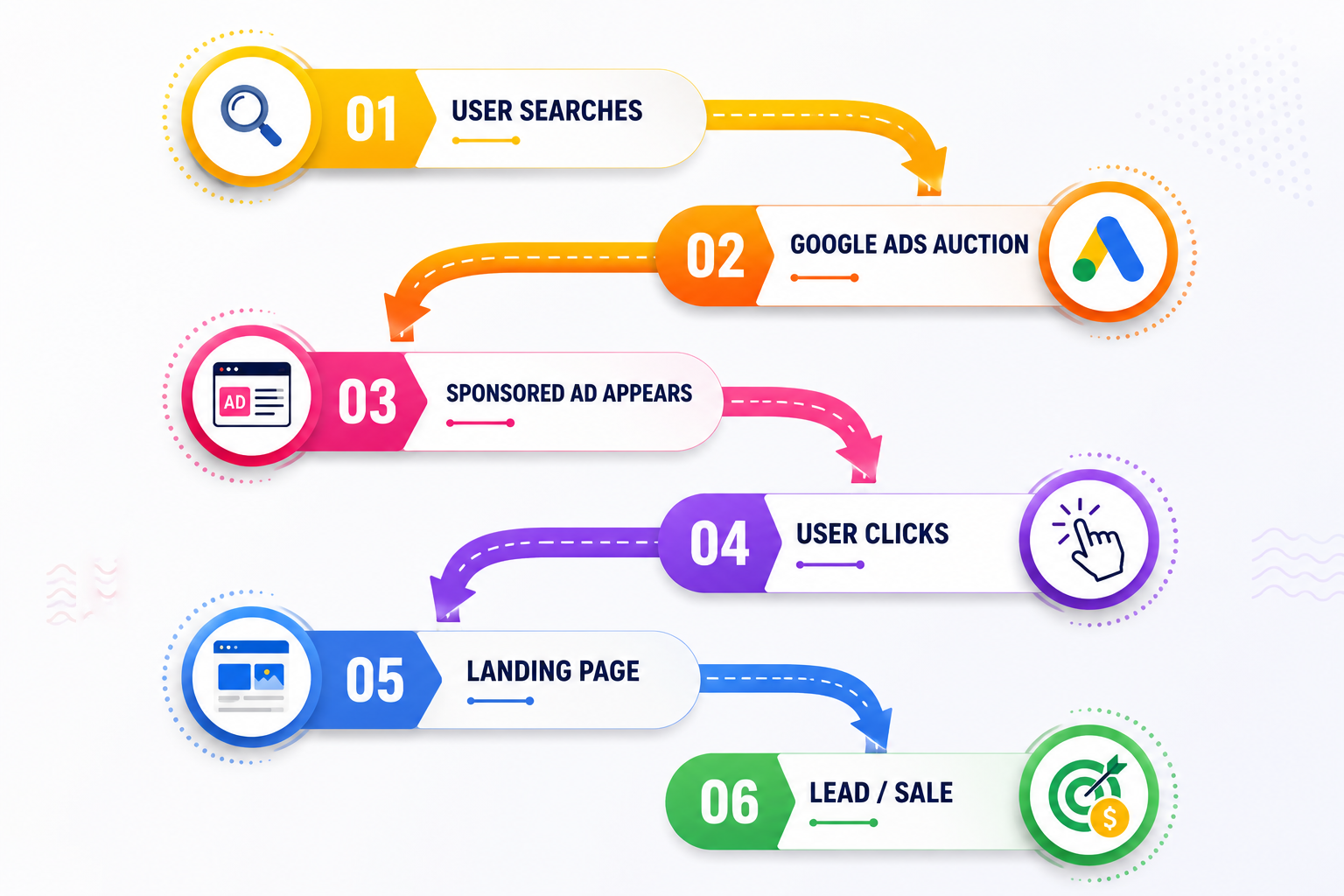
PPC advertising works through an auction system. When a user searches for a keyword, advertising platforms evaluate several factors before deciding which ads to display. These factors may include the relevance of the keyword, the quality of the advertisement, the usefulness of the landing page, and the advertiser’s bid.
The process usually follows these steps:
- A business identifies keywords that potential customers are searching for.
- Advertisements are written to match those searches.
- A budget and bidding strategy are selected.
- The ads are shown to users searching for related topics.
- The advertiser pays only when someone clicks on the advertisement.
This model allows businesses to reach people who are actively looking for information, products, or services, rather than displaying ads to a broad audience with little interest.
Why Businesses Use PPC
One of the biggest advantages of PPC is speed. While SEO focuses on long-term organic growth, PPC can generate website traffic almost immediately after a campaign is approved.
Businesses often use PPC to:
- Launch a new product or service.
- Promote limited-time offers.
- Increase website traffic.
- Generate enquiries or leads.
- Test demand for new products.
- Support seasonal marketing campaigns.
Because campaign performance can be measured in real time, advertisers can pause underperforming ads, adjust budgets, test different headlines, and improve landing pages without waiting weeks for results.
A Practical Example
Imagine a training institute that has introduced a new digital marketing course.
Instead of waiting for its website to rank organically, the institute creates a PPC campaign targeting searches such as “digital marketing course online” and “SEO training for beginners.”
When someone searches for these terms, the advertisement appears above the organic search results. Interested users click the ad and visit a dedicated landing page explaining the course syllabus, duration, fees, and registration process.
Suppose the campaign receives 500 clicks in one month, and 25 visitors enroll in the course. By comparing the advertising cost with the course revenue, the institute can determine whether the campaign is profitable and identify opportunities for improvement, such as refining keywords or improving the landing page.
This example demonstrates why PPC is often valued for its ability to deliver measurable results and provide clear insights into campaign performance.
Common Challenges
Although PPC offers quick visibility, it also requires ongoing attention. Some common challenges include selecting keywords that are too broad, creating ads that do not match user intent, directing visitors to poorly designed landing pages, and failing to review campaign data regularly.
Successful advertisers regularly monitor performance metrics, test different versions of their ads, and make gradual improvements based on real data rather than assumptions.
PPC and SEO: Working Together
PPC and SEO are sometimes viewed as competing strategies, but they often work best together.
SEO helps build sustainable organic traffic over time, while PPC provides immediate visibility for important products, services, or campaigns. Businesses that combine both approaches can benefit from consistent long-term growth while also reaching potential customers when immediate results are needed.
Pay-Per-Click advertising is more than paying for website visits. It is a measurable marketing strategy that connects businesses with people who are already searching for relevant products or services. When campaigns are carefully planned, regularly optimized, and supported by useful landing pages, PPC can become an effective channel for generating qualified traffic, leads, and sales.
Like any marketing strategy, long-term success depends not only on advertising but also on delivering genuine value to the people who click your ads.
For example, add a section like:
Experience with PPC.
When I created my first Google Ads campaign, I chose broad keywords because I wanted to reach more people. Although the campaign received many clicks, very few visitors became leads. After reviewing the search terms report, I added negative keywords and created a dedicated landing page. Within two weeks, the conversion rate improved noticeably while the cost per lead decreased. This experience taught me that PPC success depends on targeting the right audience, not simply getting more clicks.
Although PPC advertising is available on several platforms, Google Ads is the most widely used because it reaches people actively searching for products and services.
SEO vs. PPC
| Feature | Search Engine Optimization (SEO) | Pay-Per-Click (PPC) Advertising |
|---|---|---|
| Traffic Source | SEO brings organic traffic, which means visitors find your website naturally through search engine results without you paying for each visit. This traffic usually comes from people actively searching for information, products, or services related to your content. | PPC brings paid traffic, which means visitors reach your website by clicking on advertisements that you have paid to display on search engines or other platforms. This traffic is generated through ad campaigns rather than organic rankings. |
| Cost | SEO does not charge you for each click, but it still requires investment in content creation, keyword research, technical optimization, link building, and time. The main cost is usually effort, expertise, and consistency rather than direct payment for traffic. | PPC requires you to pay for every click or sometimes for impressions depending on the campaign type. The cost can increase quickly if the keywords are competitive or if the campaign is not managed carefully. |
| Time to See Results | SEO usually takes time to show results because search engines need to crawl, index, and evaluate your content before rankings improve. In many cases, noticeable results may take weeks or months, especially for new websites. | PPC can produce fast results because ads can start appearing soon after the campaign is approved. This makes PPC useful when you need immediate visibility, quick traffic, or fast lead generation. |
| Long-Term Value | SEO has strong long-term value because well-optimized pages can continue attracting visitors for months or even years after they are published. Once a page ranks well, it can keep bringing traffic without paying for every click. | PPC has limited long-term value because traffic stops when the budget ends or the campaign is paused. It is effective for short-term goals, but it does not create lasting traffic on its own. |
| Visibility | SEO visibility is earned through rankings. Your content appears in search results when search engines consider it relevant, useful, and trustworthy. Higher rankings usually lead to more clicks and better visibility over time. | PPC visibility is bought through ads. Your advertisement can appear in prominent positions at the top or bottom of search results, giving your business immediate exposure as long as you continue funding the campaign. |
| Best For | SEO is best for long-term growth, brand authority, and building a steady flow of visitors over time. It works well for businesses that want to create trust, educate users, and reduce dependence on paid advertising. | PPC is best for quick leads, promotions, product launches, seasonal offers, and urgent campaigns. It is especially useful when you need immediate traffic or want to test how well a product or service performs. |
| Budget Requirement | SEO mainly requires a time and content investment. You may spend money on writers, designers, SEO tools, or specialists, but you do not pay for each visitor. The budget is usually more flexible and focused on long-term growth. | PPC requires ongoing ad spend. You must continuously fund the campaign to keep receiving traffic. If the budget is too low or poorly managed, the campaign may not generate enough clicks or conversions. |
| Performance Tracking | SEO performance is usually tracked through rankings, organic traffic, click-through rate, engagement, and conversions. These metrics help you understand how well your content is performing in search results and whether users find it useful. | PPC performance is tracked through clicks, impressions, conversions, cost per click, cost per conversion, and return on ad spend. These numbers help advertisers measure whether the campaign is profitable and efficient. |
| Control | SEO gives you less direct control over placement because search engines decide where your pages rank based on many factors. You can improve your chances through optimization, but you cannot guarantee a specific position. | PPC gives you more control over targeting and placement. You can choose keywords, locations, devices, audience interests, ad schedules, and budgets, which makes it easier to reach a specific group of users. |
| Risk | SEO has lower financial risk because you are not paying for every click. However, it still requires patience and effort, and results are not guaranteed. If your content is weak or competition is high, progress may be slow. | PPC has higher financial risk if ads do not convert well. You may spend money quickly without getting enough leads or sales, especially if the targeting, ad copy, or landing page is not effective. |
| Example | A business publishes helpful blog posts, service pages, and guides to rank in search results for keywords such as “best digital marketing course” or “SEO services near me.” Over time, these pages attract visitors organically without paying for each click. | A business runs Google Ads or social media ads to promote a service, product, or offer. For example, it may run ads for “digital marketing course enrollment” to generate immediate enquiries from people searching for training options. |
Frequently Asked Questions (FAQs)
Is PPC better than SEO?
PPC and SEO are both effective digital marketing strategies, but they serve different purposes. PPC is ideal for businesses that need immediate website traffic or want to promote a product or service quickly. SEO, on the other hand, focuses on improving a website’s organic visibility over time and can continue driving traffic long after the content is published. Many businesses achieve the best results by combining both strategies—using PPC for short-term goals and SEO for long-term growth.
How much does PPC cost?
There is no fixed cost for PPC advertising. The amount you spend depends on factors such as your industry, competition, target audience, keywords, and campaign goals. Some businesses start with a small daily budget to test their campaigns, while larger companies invest significantly more. The advantage of PPC is that you can control your budget, monitor performance, and adjust your spending based on results.
Is PPC suitable for beginners?
Yes. PPC can be a good option for beginners because it provides measurable results and allows you to learn how online advertising works. However, creating successful campaigns requires understanding keyword research, audience targeting, ad copy, bidding strategies, and landing page optimization. Beginners often benefit from starting with a small budget, testing different approaches, and analyzing campaign performance before increasing their investment.
What is CPC?
CPC stands for Cost Per Click. It is the amount an advertiser pays each time someone clicks on their advertisement. For example, if your advertisement receives 100 clicks and your average CPC is ₹15, your total advertising cost would be approximately ₹1,500. Monitoring CPC helps businesses understand how efficiently they are using their advertising budget.
Can small businesses use PPC?
Absolutely. PPC is suitable for businesses of all sizes because campaigns can be tailored to different budgets. A small business can focus on a specific location, target a niche audience, and set a daily spending limit to avoid overspending. With careful planning and regular optimization, PPC can help small businesses compete with larger brands and reach customers who are actively searching for their products or services.