What Is Search Engine Optimization (SEO)? A Complete Beginner’s Guide
Have you ever searched for something on Google and wondered why certain websites appear on the first page while others are difficult to find? The answer often lies in Search Engine Optimization (SEO).
SEO is one of the most important digital marketing strategies because it helps businesses improve their visibility in search engine results without paying for every visitor. Instead of relying only on advertisements, SEO focuses on creating valuable content, improving website structure, and offering a better user experience so that search engines can recommend your pages to users.
Whether you run a business website, an online store, a personal blog, or a service-based company, understanding SEO can help you attract more visitors, build credibility, and grow your online presence.
What Is SEO?
Search Engine Optimization (SEO) is the process of improving a website so that it appears higher in search engine results when people search for topics related to your business, products, or services.
For example, imagine you own a digital marketing institute. If someone searches for “best digital marketing course”, you would want your website to appear near the top of the search results. SEO helps improve the chances of your website being discovered by people who are already interested in what you offer.
Unlike paid advertising, SEO generates organic traffic, meaning visitors find your website naturally through search engines without you paying for each click.
Why Is SEO Important?
Millions of searches are performed every day, and most users click on one of the first few results they see. If your website does not appear in those results, potential customers may never discover your business.
SEO is important because it helps you:
- Increase organic website traffic.
- Improve brand visibility.
- Build trust and credibility.
- Reach users actively searching for your products or services.
- Generate leads and sales without paying for every visitor.
- Create long-term value through evergreen content.
Unlike many marketing methods that stop producing results when the budget ends, well-optimized content can continue attracting visitors for months or even years.
What Real SEO Experience Teaches
In real SEO projects, the biggest improvements usually come from fixing the basics rather than chasing shortcuts. Pages that clearly answer the searcher’s question, load quickly, and are easy to navigate often perform better than pages that are simply filled with keywords.
Another important lesson is that SEO is cumulative. Small improvements in title tags, internal links, content updates, and page structure can gradually increase impressions, clicks, and rankings over time. Tools like Google Search Console often reveal opportunities that are not obvious from the website alone, such as pages with high impressions but low click-through rates.
How Do Search Engines Work?
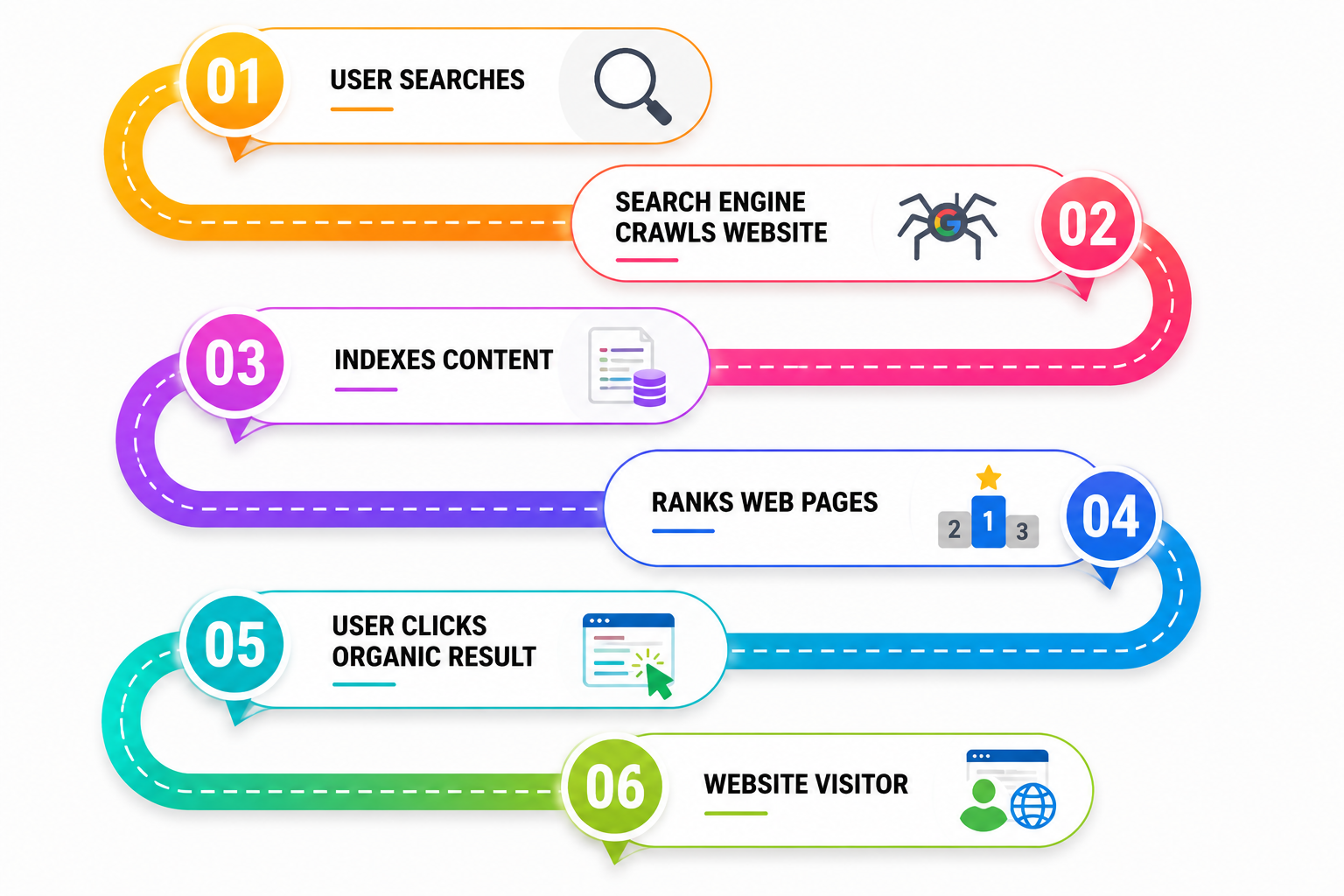
Search engines such as Google are designed to help users find the most relevant and trustworthy information as quickly as possible. Whenever you search for a topic, product, or service, Google doesn’t search the entire internet in real time. Instead, it retrieves information from a massive database called the search index. Before a webpage can appear in search results, it goes through three important stages: Crawling, Indexing, and Ranking.
1. Crawling
Crawling is the first step in the search engine process. Search engines use automated software programs called crawlers, bots, or spiders to discover new and updated web pages. These bots continuously travel across the internet by following links from one page to another. When they find new content, they read the page and collect information about its text, images, videos, and links.
For example, if you publish a new blog post and link it from your homepage or another article, search engine crawlers are more likely to discover it quickly. A well-organized website with clear navigation and internal links makes crawling easier and helps search engines find all your important pages.
2. Indexing
Once a page has been crawled, the next step is indexing. During this process, the search engine analyzes the content to understand what the page is about. It examines elements such as the page title, headings, keywords, images, and overall topic before deciding whether the page should be stored in its search index.
Think of the search index as a huge digital library. If your page is indexed, it becomes eligible to appear in search results when someone searches for a relevant topic. However, not every crawled page is indexed. Pages with duplicate, low-quality, or blocked content may not be added to the index.
3. Ranking
After a page is indexed, it can compete to appear in search results. When a user enters a search query, the search engine evaluates hundreds of ranking signals to determine which pages provide the most helpful and relevant answers.
These signals may include the quality of the content, how well it matches the user’s search intent, website speed, mobile friendliness, page security (HTTPS), backlinks from trusted websites, and overall user experience. Pages that offer useful, accurate, and trustworthy information are more likely to rank higher than pages with thin or outdated content.
The goal of the ranking process is simple: to show users the pages that best answer their questions while providing a positive browsing experience.
The pages considered most helpful, relevant, and trustworthy appear higher in the search results.
How SEO Works
SEO is not about adding keywords repeatedly. Instead, it focuses on improving every important part of your website so users have the best possible experience.
Important SEO factors include:
High-Quality Content
Content should answer the reader’s questions clearly and provide useful information rather than simply promoting products or services.
Keyword Research
Understanding the words and phrases your audience searches for helps you create content that matches their interests and needs.
User Experience
A clean layout, easy navigation, readable text, and helpful formatting encourage visitors to stay longer and explore more pages.
Website Speed
Fast-loading pages improve user satisfaction and reduce the likelihood of visitors leaving before the page loads completely.
Mobile-Friendly Design
Since many users browse on smartphones, websites should work smoothly across different screen sizes.
Secure Website (HTTPS)
A secure website protects user information and builds trust with visitors.
Website Structure
A clear website structure helps both users and search engines understand how your content is organized. Breadcrumb navigation shows visitors where they are on the site and makes it easier to move back to a category or homepage. Internal linking connects related pages so users can discover more helpful content and search engines can find important pages faster. A clean URL structure, such as /seo/keyword-research/, is easier to read and understand than long, confusing URLs with random numbers or symbols.
Internal Linking
Linking related articles helps users discover more information while helping search engines understand your website’s structure.
Backlinks
When reputable websites link to your content, search engines often view those links as a sign that your information is trustworthy and valuable.
How to Measure SEO Results
SEO should always be tracked, because what gets measured can be improved.
One of the most useful tools for this is Google Search Console. It shows which search queries bring impressions and clicks, which pages are indexed, and whether Google is facing any issues crawling your website. It also helps you identify pages with high impressions but low click-through rates, which often means the title or meta description needs improvement.
You can also use Google Analytics to understand how visitors behave after they land on your site. Together, these tools help you see not only whether your SEO is bringing traffic, but also whether that traffic is useful.
SEO vs. PPC: A Quick Comparison
SEO and PPC are both valuable digital marketing strategies, but they work in different ways.
| Feature | SEO | PPC |
|---|---|---|
| Traffic Type | Organic traffic. | Paid traffic. |
| Cost | No cost per click. | Pay for each click. |
| Time to Results | Usually takes time. | Immediate visibility. |
| Long-Term Value | Can continue for months or years. | Stops when the budget stops. |
| Best For | Long-term growth and authority. | Quick leads, promotions, and fast visibility. |
| Trust Factor | Often seen as more credible by users. | Clearly marked as sponsored. |
SEO is usually the better choice for businesses that want sustainable growth, while PPC is useful when immediate visibility is needed. In many cases, the best strategy is to use both together.
Types of SEO
Search Engine Optimization (SEO) is divided into several areas, each with a specific role in improving a website’s visibility and performance. Instead of focusing on just one aspect, successful websites combine different types of SEO to provide a better experience for users and make it easier for search engines to understand their content. The four main types of SEO are On-Page SEO, Off-Page SEO, Technical SEO, and Local SEO.
On-Page SEO
On-Page SEO refers to all the optimization activities performed directly on your website. It includes creating high-quality and original content, using relevant keywords naturally, writing clear headings, optimizing images, improving internal linking, and ensuring that each page provides useful information to visitors. The goal of On-Page SEO is to make your content easy to read, relevant to the user’s search intent, and simple for search engines to understand. Well-optimized pages often provide a better user experience, which can improve both search rankings and visitor engagement.
Off-Page SEO
Off-Page SEO focuses on improving your website’s reputation and authority through activities that take place outside your website. One of the most important factors is earning backlinks from trusted and relevant websites, as these links act like recommendations for your content. Off-Page SEO also includes brand mentions, customer reviews, guest posting, and social media sharing. Building a strong online reputation helps search engines recognize your website as a reliable source of information, which can positively influence your rankings over time.
Technical SEO
Technical SEO involves optimizing the technical aspects of your website to ensure that search engines can easily crawl, index, and understand your pages. This includes improving website speed, making the site mobile-friendly, using HTTPS for security, fixing broken links, creating XML sitemaps, and resolving crawl or indexing issues. Even if your content is excellent, technical problems can prevent search engines from accessing it properly. A technically optimized website not only supports better rankings but also provides a smoother experience for visitors.
Local SEO
Local SEO is designed to help businesses appear in search results for people looking for products or services in a specific geographic area. It is especially beneficial for businesses such as restaurants, clinics, coaching institutes, retail stores, hotels, salons, and repair services. Local SEO involves optimizing your business profile, maintaining accurate contact information, collecting genuine customer reviews, and creating location-specific content. By improving your local online presence, you increase the chances of attracting nearby customers who are actively searching for the services you offer.
Benefits of SEO
Businesses invest in SEO because it offers long-term advantages.
Some key benefits include:
- Attracts highly targeted visitors.
- Improves website credibility.
- Generates sustainable organic traffic.
- Reduces dependence on paid advertising.
- Increases brand awareness.
- Supports long-term business growth.
- Delivers measurable results through analytics.
Original SEO Case Study
Case Study: A Local Digital Marketing Institute
A small digital marketing institute wanted more admissions but was relying mostly on social media posts and occasional paid ads. Its website had useful information, but the pages were not well structured, the URLs were inconsistent, and the blog had very little internal linking. Organic traffic was low, and most visitors were not finding the course pages through Google.
What Was Done
Over a four-month period, the following SEO improvements were made:
- Rewrote the homepage and course pages to match search intent more clearly.
- Added keyword-focused titles and meta descriptions.
- Improved the URL structure so pages were short and descriptive.
- Added breadcrumb navigation to help users move through the site more easily.
- Connected related blog posts with internal links.
- Published helpful articles targeting long-tail searches such as “SEO course for beginners” and “how to learn digital marketing at home.”
- Submitted the sitemap in Google Search Console and checked indexing issues.
- Improved page speed and mobile readability.
Results
After four months, the website showed clear improvement:
- Organic impressions increased significantly.
- More pages were indexed properly.
- Several long-tail keywords started appearing on the first page of Google.
- The course pages received more clicks from search results.
- Enquiry forms increased because visitors were landing on more relevant pages.
What This Shows
This example shows that SEO does not always require complicated tactics. In many cases, better structure, clearer content, stronger internal linking, and proper tracking in Google Search Console can create meaningful growth.
Common SEO Mistakes
Many beginners make mistakes that limit their website’s performance.
Some of the most common include:
- Publishing copied or low-quality content.
- Writing only for search engines instead of readers.
- Ignoring page speed.
- Forgetting mobile optimization.
- Using misleading page titles.
- Neglecting internal linking.
- Failing to update outdated content.
- Targeting keywords without understanding user intent.
Avoiding these mistakes can improve both user experience and search visibility.
SEO Best Practices
Successful SEO is built on consistency and quality.
Follow these best practices:
- Publish original and helpful content.
- Answer real questions from your audience.
- Research keywords before writing.
- Keep articles updated with current information.
- Improve website speed and mobile usability.
- Use descriptive headings and images.
- Link related pages together.
- Monitor performance using tools like Google Search Console and Google Analytics.
- Refine your content over time based on real data.
Frequently Asked Questions
How long does SEO take to show results?
SEO is a long-term strategy. While some improvements may be visible within a few weeks, meaningful growth often takes several months. The timeline depends on factors such as competition, website quality, and the consistency of your optimization efforts.
Is SEO free?
You do not pay search engines for each visitor generated through SEO. However, creating high-quality content, maintaining your website, conducting keyword research, and improving technical performance may require time, expertise, or financial investment.
Can beginners learn SEO?
Yes. Many people begin learning SEO by understanding keyword research, content creation, website optimization, and basic analytics. With regular practice and continuous learning, beginners can gradually improve their skills.
Is SEO better than paid advertising?
SEO and paid advertising serve different purposes. SEO focuses on long-term organic growth, while paid advertising provides immediate visibility. Many businesses combine both strategies to achieve balanced and sustainable results.
Conclusion
Search Engine Optimization is much more than improving rankings on search engines. It is about creating valuable content, providing an excellent user experience, and helping people find accurate information when they need it.
Businesses that consistently publish original content, improve website performance, organize their pages clearly, and focus on solving real user problems are more likely to build trust, attract organic traffic, and achieve long-term online success. Although SEO requires patience, its long-lasting benefits make it one of the most valuable digital marketing strategies for businesses of all sizes.
If you’re new to SEO, focus on creating helpful content, improving your website’s speed, and understanding what your audience is searching for. Small, consistent improvements often produce better long-term results than trying to find quick shortcuts.